GPS vs. Laser Rangefinders: Which Is Better for Golf?
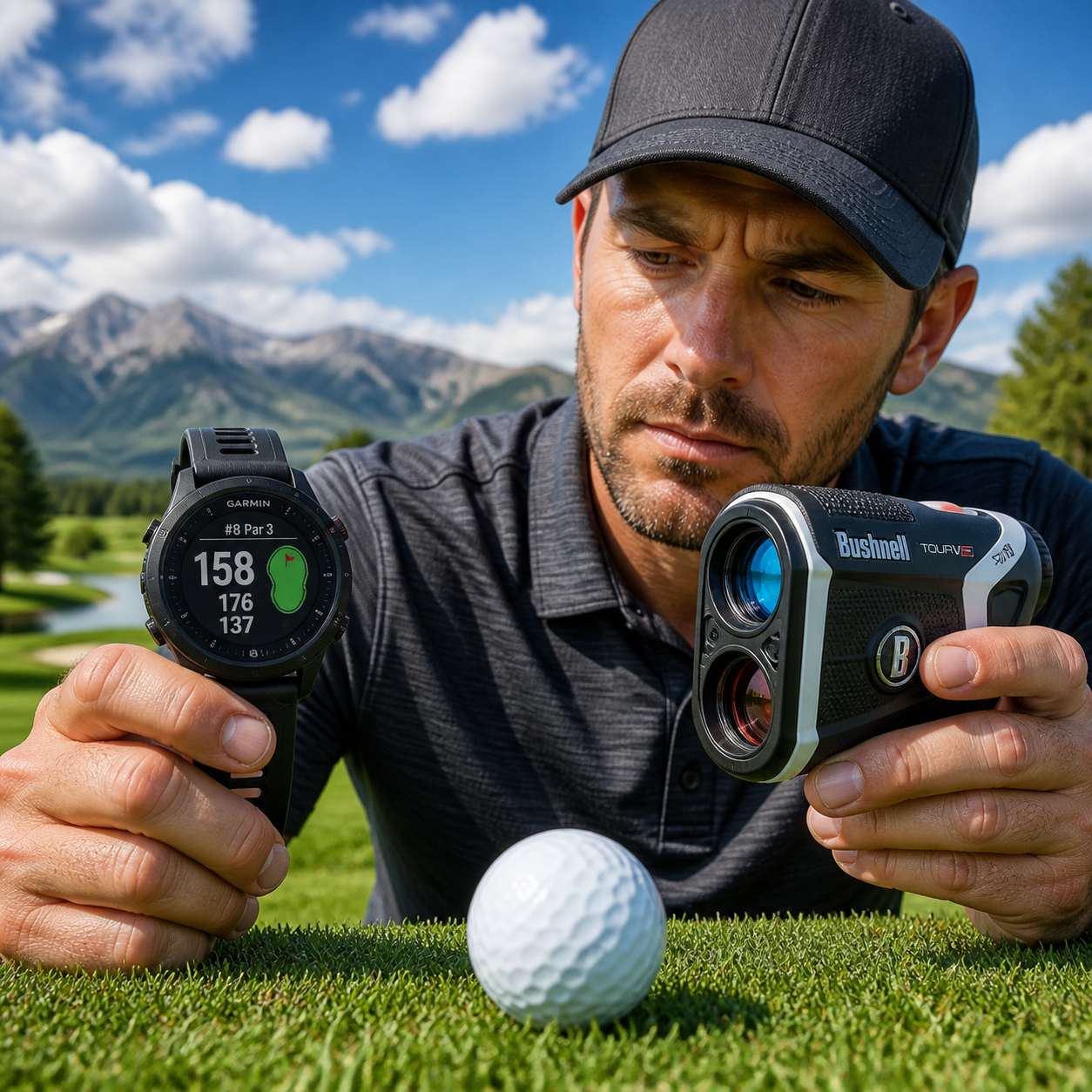
GPS golf devices and laser rangefinders solve the same basic problem: helping golfers choose the right club and plan the next shot. They approach distance differently. A GPS device shows mapped information about the hole, while a laser rangefinder measures a specific target through direct line of sight.
The better choice depends on what you need most. Golfers who value hazards, green layouts, and front, middle, and back-of-green distances often prefer GPS. Players who want a precise pin distance and a simple, focused tool may prefer a laser rangefinder. Many experienced golfers eventually use both.
How GPS Golf Devices and Laser Rangefinders Work
GPS golf devices use satellite positioning and digital course mapping to estimate your location and display distances to important points. Laser rangefinders emit a laser toward a visible target, then calculate the distance by measuring how long the reflected signal takes to return.
A golf GPS device typically identifies the hole you are playing and places your position on a preloaded course map. Depending on the model, it can show the distance to the front, middle, and back of the green, bunkers, water hazards, doglegs, layup points, and other strategic targets. Some devices appear as watches, handheld units, or small cart-mounted screens.
A laser rangefinder works more like an optical measuring tool. You look through the viewfinder, aim at the flagstick or another target, and activate the measurement. The device then provides a target distance, often with a magnified view and a target-locking signal.
These different methods create a useful distinction:
- GPS asks: Where am I on the hole, and what distances or hazards should I consider?
- Laser asks: How far away is that exact visible target?
GPS depends on satellite reception, accurate course mapping, and a charged device. A laser depends on line of sight, steady aiming, and a visible target. Neither tool eliminates the need to account for wind, lie, elevation, turf, or changing golf course conditions.
GPS vs. Laser Rangefinders: Key Differences
The main difference is information breadth: GPS golf devices provide a wider view of the hole, while laser rangefinders specialize in measuring a chosen target. GPS is usually faster for general planning; a laser can be more precise when you need the pin distance.
| Factor | GPS golf device | Laser rangefinder |
|---|---|---|
| Distance information | Front, middle, back, hazards, layups, and mapped targets | Direct measurement to a visible target |
| Pin distance | Usually an estimate based on green position or pin location | Direct measurement to the flagstick when visible |
| Speed | Very fast for an overview of the hole | Fast after aiming, but requires target acquisition |
| Course strategy | Strong, especially for hazards and layup planning | Limited unless paired with a course map |
| Line of sight | Usually unnecessary | Required for the selected target |
| Power source | Rechargeable battery | Often replaceable or rechargeable battery |
| Learning curve | Simple, although advanced features take practice | Simple operation, with aiming as the main skill |
GPS also tends to support a smoother routine. You can glance at a watch or handheld screen and immediately see the hole layout. A laser rangefinder may take a few extra seconds to locate the flag, especially when the background is busy or the target is partly obscured.
The trade-off is detail versus focus. Choosing GPS for strategic information means accepting that its pin distance may be less exact. Choosing a laser for target precision means accepting that it will not automatically reveal every hazard or layup option.
Accuracy and Distance Measurement on the Golf Course
GPS distances are accurate enough for most golfers’ shot planning, while a laser rangefinder usually offers the better measurement for a visible pin or precise target. The practical difference matters most when a few yards could change club selection or when the green has a difficult shape.
GPS golf devices calculate distances from your position to mapped points. Their usefulness depends on the quality and currency of the course map, satellite reception, and how accurately the device places your position. Front, middle, and back-of-green distances remain valuable because they describe the landing area rather than pretending that every shot should target the flag.
A laser rangefinder measures the actual pin distance when the flagstick is visible and easy to isolate. Its target locking feature can confirm that the device has captured the flag rather than a tree, bunker edge, or background object. On a clear approach, that direct measurement can support highly specific shot planning.
However, laser accuracy has practical limits. Fog, rain, glare, shaking hands, distant targets, and a flagstick hidden behind a mound can make measurement slower or impossible. A laser also tells you the distance to the target, not whether that target is the correct strategic choice.
Consider a par five with water short of the green. GPS may show the carry distance to the hazard, the safe layup area, and the front and back of the green. A laser can then measure a visible tree or flagstick. Used separately, each gives only part of the decision. Together, they provide both context and confirmation.
For tournament use, check the applicable Rules of Golf and local committee conditions. Slope compensation and other elevation-measuring features may be restricted in competition, even when the device itself is otherwise permitted. The USGA Rules of Golf provide the relevant governing framework in the United States.
Features That Matter to Golfers
The most valuable golf distance-device features are the ones that improve a real decision: choosing a safe target, selecting a club, avoiding a hazard, or understanding the usable area of the green.
Course mapping and strategic information
GPS course mapping is the stronger option for seeing the whole hole. Useful screens may include:
- Front, middle, and back-of-green distances
- Hazard locations and carry distances
- Layup points and landing zones
- Dogleg corners and fairway endpoints
- Green shape, depth, and sometimes pin-position input
This information helps golfers avoid a common mistake: hitting toward the flag without checking what lies short, long, or beside it.
Slope compensation and target locking
Slope compensation estimates how elevation changes affect the effective playing distance. It can be helpful on hilly courses, but it should support judgment rather than replace it. Wind, lie, temperature, and shot shape still influence the result.
Target locking is a major laser feature. It confirms that the rangefinder has identified the intended target and can make pin measurement easier for golfers who struggle to hold a steady aim.
Readability, weather, and battery life
A bright display, clear numbers, physical buttons, and a waterproof design matter more than a long feature list. A GPS device with excellent mapping is of little use if its screen is hard to read in sunlight. A laser with strong optics is less helpful if rain or fog regularly prevents a clean view.
Battery life deserves a pre-round check. GPS devices need charging, and continuous GPS use can drain a small watch faster than occasional handheld use. Laser rangefinders may last many rounds on a replaceable battery, but rechargeable models still need monitoring. Carrying a backup power source is sensible for long rounds or golf trips.
Which Is Better for Different Types of Golfers?
GPS is usually better for beginners and course strategists, while a laser rangefinder often suits experienced players who prioritize exact pin distance. Casual golfers may choose based on convenience, and competitive players should consider both performance needs and event regulations.
Beginners
A GPS device is often the gentler starting point. Front, middle, and back distances are easy to understand, and hazard information encourages better decisions without requiring precise aiming. Beginners can focus on landing areas instead of chasing a pin they cannot consistently reach.
Casual and recreational golfers
Choose GPS if you want a quick glance at the hole and do not want to stop and aim at every flag. Choose a laser if you enjoy measuring targets and mainly want a pin distance. For occasional play, simplicity and battery convenience may matter more than advanced statistics.
Experienced and competitive players
A laser rangefinder can be valuable for precise approach shots, especially when the pin is visible and the golfer has reliable distance control. GPS remains useful for planning tee shots, layups, and blind approaches. Competitive players should verify whether slope compensation is allowed before using it in an event.
Course strategists
Golfers who think in terms of landing zones, miss areas, and risk-reward choices should lean toward GPS. It exposes the structure of the hole before the shot begins. A laser can add precision, but it cannot replace a complete course map.
A practical selection rule is the Map-Pin-Tempo test: choose GPS when you need the map, choose a laser when you need the pin, and choose the device that keeps your routine quick enough to maintain tempo.
Can You Use a GPS Device and Laser Rangefinder Together?
Yes, golfers can use a GPS device and laser rangefinder together, and the combination often provides the most complete distance information. GPS supplies the strategic picture; the laser confirms a specific visible target.
A simple two-stage routine works well:
- Use GPS from the tee or fairway to identify hazards, carry distances, layup points, and the front, middle, and back of the green.
- Use the laser only when a precise pin, bunker edge, tree, or landing target will affect the club choice.
- Compare the measured target with the green depth and surrounding trouble before committing to the shot.
This approach avoids using the laser for every decision. It also prevents GPS users from treating a center-of-green number as the entire strategy. The main disadvantages are extra cost, more equipment to carry, and the possibility of slowing play if you measure unnecessarily.
For many golfers, a GPS watch plus a compact laser creates a practical division of labor. The watch remains available throughout the round, while the laser comes out for important approach shots.
Final Verdict: Choosing the Right Golf Distance Device
GPS golf devices are better for broad course information and efficient shot planning, while laser rangefinders are better for direct pin distance and focused target measurement. Neither is universally superior; the right choice depends on how you make decisions on the course.
- Choose GPS if you want hazards, layup distances, green layouts, front/middle/back numbers, and quick access without line of sight.
- Choose a laser if you prioritize pin distance, target locking, direct measurement, and a simple device with few distractions.
- Use both if you play strategically and want exact target confirmation on demanding approach shots.
Budget and convenience should decide the final step. A GPS device may provide more information per glance, while a laser may deliver the specific number you trust most. Check charging requirements, weather resistance, display readability, mapping coverage, and competition rules before buying.
The strongest distance tool is the one you will use consistently and interpret intelligently. Start with the information your game currently lacks: if you miss because you overlook hazards and landing zones, choose GPS; if you already plan well but need reliable pin distances, choose a laser rangefinder.
GPS and Laser Rangefinder FAQs
Are GPS golf devices accurate enough for most golfers?
Yes. GPS distances are generally sufficient for recreational and many competitive golfers, particularly when using front, middle, and back-of-green numbers. Their value often comes from strategic context rather than pin-level precision.
Are laser rangefinders better for measuring pin distance?
Usually, yes. When the flagstick is visible, a laser rangefinder directly measures pin distance and may confirm the lock with vibration or another target-locking signal.
Do GPS golf devices show hazards and layup distances?
Many GPS golf devices do. Available information varies by model and course map, so check whether the device includes hazard positions, carry distances, layup points, doglegs, and green details.
Is a rangefinder with slope legal for tournament play?
It depends on the event rules and local conditions of competition. Slope compensation is commonly restricted when the rules prohibit measuring elevation changes. Confirm the event policy before play.
Can golfers use both GPS and laser devices?
Yes. Many golfers use GPS for course mapping and broad shot planning, then use a laser to confirm the distance to a visible pin or target.